
The Best Carp Fishing Hooks for 2026

So unless you are extremely nifty with a landing net, you cannot catch carp without a hook. It is simply a fundamental piece of equipment in the world of angling.
With it being such a crucial part of a fisherman's arsenal, surely you should spend as much time and effort in choosing the best carp hook for your circumstances as any other part of your fishing tackle. Yet quite often, this key fundamental is overlooked by novice carp anglers.
This article will explain everything you need to know to choose the best carp fishing hook for your specific fishing situation. We have also created a handy carp fishing hook size chart for easy reference.
Quick Answer
The best carp hook is the one that suits the rig: the Korda Wide Gape is my pick as the do-it-all pattern most anglers should start with.
From there it is about matching the hook to the presentation. The table below lays out the shortlist by the job each hook does, from wide gape and long shank for bottom baits to curved and stiff-rig patterns for pop-ups and chods.
| Rank | Best for | Hook | Best suited to |
|---|---|---|---|
| #1 | Best All-Rounder | Korda Wide Gape | Anglers who want one do-it-all hook for bottom baits and wafters. |
| #2 | Long Shank for Bottom Baits | Korda Longshank X | Anglers fishing simple bottom-bait rigs who want fast, aggressive hooking. |
| #3 | Curved Shank for Pop-Ups | Gardner Dark Mugga | Anglers fishing pop-ups, wafters, Ronnie and spinner-style rigs. |
| #4 | For Chod & Stiff Rigs | Fox Stiff Rig Beaked | Anglers fishing chods and stiff hinged rigs over silt or weed. |
| #5 | Best on a Budget | Fox Edges Armapoint Wide Gape | Anglers who get through hooks and want value without losing performance. |
What to look for in a carp fishing hook
I guess a good place to start (and forgive me for potentially teaching you to suck eggs here) is to explain the terminology used when talking about different parts of a carp fishing hook.
The best way to show you this is via the following diagram showing the individual parts of a carp hook...
When choosing the best carp hook for your specific angling situation, a number of factors need to be considered. These include the following:
- Hook size
- Eye position
- Hook gauge
- Hook point angle
- Hook gape
- Hook shank length
- Hook bend
- Carp fishing hook brand
- Hook colour
- Barbed or barbless hooks?
- The sharpness of the hook
Let's go through each of these factors and explain more...
What is the best hook size for carp fishing
This question is difficult to answer as it depends on a number of factors. The 3 most important considerations when choosing the size of your hook are as follows:
- What carp rig you are using
- What size fish you are going for
- What sized carp bait you are using
How your carp rig dictates your hook size
With the emergence of new and innovative carp rigs being used in the angling world today, your choice of rig will sometimes dictate what hook size you use.
For example, a zig rig will fish better with a smaller hook and a Ronnie rig naturally will be more conducive to a larger hook.
You can check out our full and comprehensive guide on carp fishing rigs for beginners for more information on different types of rigs and how to tie them.
As a quick guide, however, check out the following table that summarises recommended hook sizes with certain rigs:
A table showing the recommended components of carp rigs:
| Rig | Hook-link Material | Hook-link Length | Hook Size | Hook Type | Recommended Bait |
|---|---|---|---|---|---|
| Standard Bottom Bait | Braid, Mono, Fluoro or Stiff | 6 to 10 inches | 4 to 10 | Wide Gape or Long-Shank | Any Bait |
| Standard Popup Rig | Braid or Stiff | 6 to 10 inches | 4 to 10 | Wide Gape | Any Buoyant Bait |
| D-Rig Bottom or Popup | Mono, Fluoro or Stiff | 6 to 10 inches | 4 to 8 | Wide Gape or Stiff Rigger | Boilie, Pellet or Particle |
| Blowback Rig Bottom or Popup | Braid, Mono, Fluoro or Stiff | 6 to 10 inches | 4 to 8 | Wide Gape or Stiff Rigger | Boilie, Pellet or Particle |
| Chod Rig | Mono or Fluoro | 1 to 3 inches | 4 to 8 | Stiff Rigger | Popup Boilie |
| Ronnie Rig | Braid, Mono, Fluoro or Stiff | 4 to 8 inches | 4 to 6 | Curved Shank | Popup Boilie |
| Zig Rig | Mono or Fluoro | Set to required depth | 8 to 12 | Wide Gape or Stiff Rigger | Rig Foam, Popup Boilie, or Dog Biscuit |
How carp size dictates your hook size
It may sound obvious but the larger a carp is the larger and thicker their mouths are. With this fact in mind, if you are fishing for the real specimens in a water you are going to need a larger hook to have a better chance of hooking a fish in the first place let alone landing it.
This isn't to say that you cant catch large carp on smaller hooks, it is just a case of increasing your chances of catching.
On the contrary, if smaller fish are your prey then a large hook has the potential to be overkill and may even spook fish. For this reason, a less conspicuous, smaller hook will be the order of the day.
How carp bait size affects your hook size choice
A really important factor of a successful carp rig is making the bait offering as natural as possible. If the hook bait sticks out like a sore thumb amongst your free offerings then a clever carp will simply ignore it.
For this reason your hook size should marry with your hook bait in order for the bait to be the focal point of the fish and not an oversized hook.
Check out this carp fishing hook size chart that provides a great indicator of what hook size to choose considering both fish size and bait size:
Carp Fishing Hook Size Chart
Carp Size | Smallest hook size (small baits) | Largest hook size (large baits) |
|---|---|---|
0 - 5lb | 20 | 14 |
5 - 10lb | 16 | 12 |
10 - 20lb | 10 | 6 |
20 - 30lb | 8 | 4 |
30 - 40lb | 6 | 4 |
40lb+ | 6 | 2 |
What is the best eye position on a carp fishing hook
There are three different angles of hook eye in the vast majority of carp hooks. These are in-turned (pointing towards the point), out-turned (pointing away from the point), and straight.
What eye type you use is quite often down to personal preference. We prefer to use in-turned eyes due to the anti-eject properties of the line angle that this creates. You can also create this same angle using a straight-eyed hook and shrink tubing bending the line towards the point.
Straight-eyed hooks are more suited for bottom baits with braid being a good match to a straight-eyed hook.
Some carp anglers swear by an out-turned eye, especially when using pop-ups due to an enhanced presentation of this type of bait. It is particularly popular when using stiff monofilament and fluorocarbon hook-link materials.
The following picture shows the different hook eye types:

Hook gauge
The hook gauge is simply just the thickness of the hook itself. A thick-gauge could make the hook too obvious to the fish and prevent takes. A gauge that is too thin could indicate a weak hook that is prone to snapping.
The majority of carp hooks on the market from reputable brands will provide the correct gauge to size ratio so for the most part you don't have to worry about this factor.
What is the best hook point type?
There are two main types of hook point type, or to be more concise hook point angle to choose from. These are straight point and beaked. From our experience, the hook point type you choose is dependant on your rig choice.
Straight hooks have the advantage of being less prone to snagging so could be better suited to weedy waters. They are known to initially hook fish better but equally have more chance of fish dropping off compared to the claw-like beaked hook point. Straight hooks tend to be easier to sharpen out of the two.
Beaked hook points tend to blunt less easily and, as previously mentioned, seem to have a superior hook hold. Again, it is largely down to personal preference and experience to what hook point type you use as they both have their advantages and disadvantages, we have experienced equal success with both types.

The sharpness of your carp hook
Talking about hook points, one thing that is absolutely key to being successful at carp fishing is ensuring you are always fish with a sharp hook. Hooks can blunt by hitting general debris and vegetation within the water.
For this reason, we recommend you sharpen your hook between casts. There are many hook sharpeners on the market today. One of our favourites is this one by NGT as it comes with a clamp and a pouch and offers great value for money...

HOOK SHARPENING VICE TOOL CLAMP WITH HOOK SHARPENER AND STORAGE POUCH
Check out the following video that takes you through how to sharpen your hook effectively...
Hook gape
The gape of the hook is quite simply the measurement between the point and the shank of the hook. The gape width does vary between hook types.
There are hooks that are designed purposely to have a wide hook gape. These hooks tend to be the most common hook type amongst carp anglers as they are great for most angling situations. A wide gape suits a larger bait better such as boilies or large pellets.
A narrower gape does very much have it's uses especially when using smaller baits such as sweetcorn or maggots.
The following picture shows the two different hook gape widths:

Hook shank length
Similar to the gape width, different hook types come with different shank lengths and bends. The general classification for shank length is either just standard (sometimes called short) or long shank.
The standard shank is most commonly used in carp fishing however the long shank has its uses and is popular when fishing with particles. A long shank also tends to achieve a stronger hook hold than its shorter counterpart.
In terms of bend, there are either curved shank hooks or straight shanked hooks. Straight shanks tend to be used for the majority of carp rigs however curved shanks are critical for some more technical rigs such as the KD rig.
The following picture shows an example of the different hook shank types:

What is the best carp fishing hook colour?
One of the key attributes of a good carp fishing rig is its ability to be as inconspicuous as possible to feeding fish.
To help with keeping things looking as natural as possible it's good practice to match your carp hook colour to either the bait and/or the bottom composition of the water you are fishing so as to blend in.
The following are the most common hook colours on the market and when best to use each one:
- Silver - Most commonly used with coarse fishing tactics such as float fishing for carp.
- Black - The most common coloured hook in carp fishing. Good in most circumstances but particularly in silty or gravel-based waters.
- Gold - Another popular colour with general coarse fishing tactics. Gold hooks can be a great choice when fishing with particles such as sweetcorn or maize.
- Brown - Effective in muddy or sandy waters.
- Dark Green - A great choice for waters with a lot of vegetation and/or weed present.
Barbed vs barbless carp hooks
This is a subject that always has and always will divide opinion in the angling world.
Most fisheries will stipulate in their rules whether barbed hooks are allowed or not. Some may even prefer barbed (or micro-barbed) over barbless hooks.
It is very much a matter of opinion so what we will always advise is to follow the rules of the fishery. This is because they will always have what's best for their fish's welfare at heart when devising the rules on barbed hooks.

What are the different brands of carp fishing hook?
As with all fishing tackle, there are certain brands that excel in certain areas. For example, Daiwa has a fantastic reputation for producing great carp rods and big pit reels. Shimano excel with bait-runners and Delkim bite alarms are top-notch.
In terms of carp fishing hooks, there are three key players that we turn to when looking at purchasing carp hooks and these are as follows:
The top 3 carp fishing hook brands:
- Korda
- Gardner
- Fox
All three of these brands produce hooks of all different types and sizes, with a number of options that tick the boxes detailed above. They also all have a good reputation for quality.
Our recommendation for the best carp fishing hooks?
Korda Wide Gape
#1 Best All-Rounder
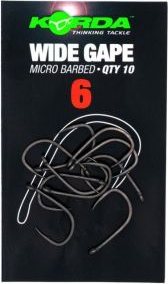
The Korda Wide Gape is the hook I tie on when I am not sure what else to use, because it just does everything. The wide gap and beaked point make it a superb all-round pattern for bottom baits and wafters alike.
That wide gape gives plenty of room around the bait and a lot of hook-hold once it takes, which is why it has been a rig-tying staple for years. The beaked point resists being turned over on gravel or clay.
It is strong and chemically sharp out of the packet, in a subtle dull finish that hides well against the lakebed. I run it in a 6 for bigger baits down to a 10 for smaller stuff.
There are hooks that do one job better, but for a single pattern to cover most of my fishing, the Wide Gape is the one I would never be without.
Best suited to
Anglers who want one do-it-all hook for bottom baits and wafters.
Pros
- Superb all-round pattern
- Beaked point resists blunting
- Strong and sharp out of the packet
Cons
- A jack-of-all-trades, not a specialist
- Not aimed at stiff or chod rigs
Korda Longshank X
#2 Long Shank for Bottom Baits
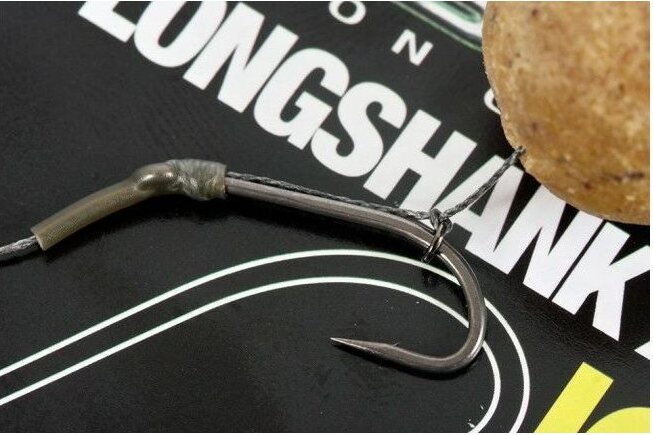
When I am fishing a bottom bait and want an aggressive, fast hook-hold, the Korda Longshank X is my choice. The extended shank flips the hook and turns it into the bottom lip quickly.
That longer shank acts like a lever, so as a carp moves off the hook rotates and grabs hold before it can eject the bait. On a simple bottom-bait rig it is a deadly, low-maintenance pattern.
The X version is a beefed-up, stronger wire than the standard, so it stands up to big fish and snaggy swims without opening out. The point is sharp and the finish dull and low-key.
It is a specialist bottom-bait hook rather than an all-rounder, but for pinning fish down over a bed of bait it is hard to beat.
Best suited to
Anglers fishing simple bottom-bait rigs who want fast, aggressive hooking.
Pros
- Long shank flips and hooks fast
- Strong X wire for big fish
- Deadly on simple bottom-bait rigs
Cons
- A specialist, not an all-rounder
- Long shank not suited to every rig
Gardner Dark Mugga
#3 Curved Shank for Pop-Ups
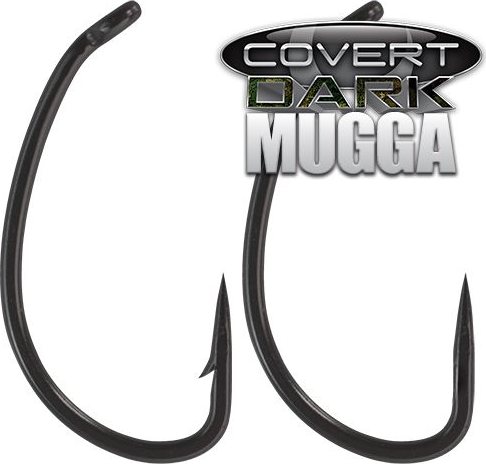
The Gardner Dark Mugga is my go-to curved-shank hook, and it is a brilliant pattern for pop-ups and lighter presentations. The aggressive curved shank and in-turned eye make it flip and grab fast, with a sharp straight point.
That shape is what makes it so good with a pop-up or a wafter on a short hooklink: it turns quickly and takes a firm hold in the bottom lip. It is a favourite for Ronnie and spinner-style rigs too.
Gardner sharpen these to a genuinely sticky point, and the dark, non-reflective finish keeps it hidden. The wire is strong enough for big fish while staying fine enough to prick easily.
For pop-up work it is one of the most reliable hooking patterns I have used, and it has become a permanent fixture in my rig wallet.
Best suited to
Anglers fishing pop-ups, wafters, Ronnie and spinner-style rigs.
Pros
- Curved shank flips fast on pop-ups
- Genuinely sticky-sharp point
- Dark, non-reflective finish
Cons
- Aggressive shape not for every rig
- Fine point needs careful handling
Fox Stiff Rig Beaked
#4 For Chod & Stiff Rigs
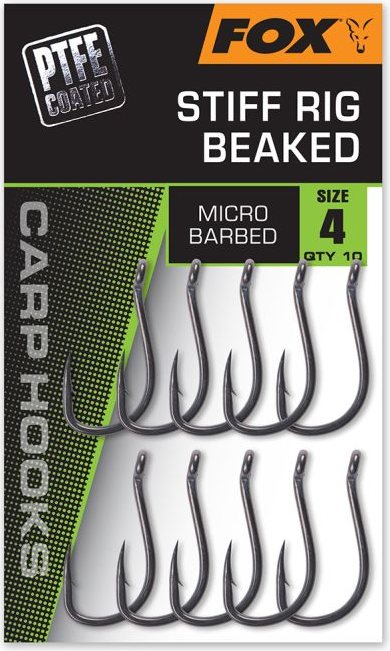
For chods and stiff hinged rigs I want a short, stout hook with an out-turned eye, and the Fox Stiff Rig Beaked is built for exactly that. It is a specialist pattern that makes those rigs work.
The out-turned eye lets the stiff hooklink or boom sit at the right angle to flip and catch hold, which is the whole point of a chod or stiff-rig presentation over silt or weed.
It is a short, strong hook with a beaked point and a PTFE coating, so it holds well and resists blunting on a hard lakebed. The forged steel wire is strong for its size, which matters when the rig is fished locked up.
It is not a hook for every rig, but if chods and stiff rigs are part of my fishing, this is the pattern I trust to turn them into fish.
Best suited to
Anglers fishing chods and stiff hinged rigs over silt or weed.
Pros
- Out-turned eye made for stiff rigs
- Short, strong, PTFE-coated pattern
- Beaked point holds on hard ground
Cons
- A dedicated chod/stiff-rig hook
- Wrong choice for supple rigs
Fox Edges Armapoint Wide Gape
#5 Best on a Budget
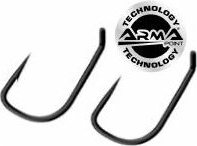
The Fox Edges Armapoint Wide Gape is the budget-friendly pick that still fishes like a premium hook. The Armapoint finish gives it a genuinely sharp, hard-wearing point that lasts.
As a wide-gape straight-point pattern it is a great all-rounder for bottom baits and wafters, covering most of the fishing the everyday angler does. The wide gape gives good bait clearance and hook-hold.
The point holds its edge well against gravel, so it keeps fishing effectively for longer than a lot of cheaper hooks. The dull finish keeps it discreet on the deck.
For an angler who gets through a lot of hooks and does not want to spend a fortune, it is superb value without giving much away to the dearer patterns.
Best suited to
Anglers who get through hooks and want value without losing performance.
Pros
- Premium performance at a low price
- Hard-wearing Armapoint point
- Versatile wide-gape all-rounder
Cons
- Not the sharpest premium pattern
- A generalist, not a specialist
Carp Hook FAQs
Still deciding which hook to tie on?
These are the questions I would settle before buying.
What size hook should I use for carp?
There is no single answer, but a size 6 or 8 covers most carp fishing with 15mm to 18mm baits, which is where I start. Bigger baits and bigger fish call for a larger hook, smaller baits a smaller one.
The key is to balance the hook to the bait and the rig so the hookbait sits and behaves naturally. A hook that is too big looks unnatural, one too small can struggle to take hold.
What hook size suits a 15mm boilie?
For a 15mm boilie I would use a size 6 or 8 in most patterns. That gives enough gape to clear the bait and set cleanly without looking oversized next to it.
If the fish are wary I might drop a size to keep things subtle, and step up if I am fishing for big, hard-fighting carp in a snaggy swim.
Are barbed or barbless hooks better for carp?
It usually comes down to the fishery rules rather than performance. Many waters are barbless-only for fish safety, so I always check before I fish.
Both hold fish well with a tight line and a decent bend in the rod. Barbless are kinder to the fish and easier to unhook, while a micro-barb can give a little extra security where it is allowed.
How do I keep my hooks sharp?
I check the point regularly by dragging it across a thumbnail: if it grabs, it is sharp; if it slides, it is done. A blunt hook costs fish, so I change it without a second thought.
Fishing over gravel or casting onto hard ground blunts a point fast, so a hook that has taken a hard cast or two is worth checking. Some anglers sharpen their own, but for most a fresh hook is simpler.
Can I catch big carp on small hooks?
Yes. A sharp, strong small hook fished on a balanced setup will land big fish, and a smaller pattern often gets more bites from wary carp.
The important thing is that the wire is strong enough for the fish and the point stays sharp. I would rather fish a quality small hook than a cheap large one.
Final Thoughts
Hopefully, this article has given some insight into the importance of really thinking about your hook choice before you buy or tie your carp rig. This key decision can really be the difference between fish on the bank or a total blank.
Thanks for reading.
Tight Lines!
Related Articles...

Best Carp Rigs For Beginners
In this article, we take you through everything you need to know about carp fishing rigs for beginners from what tools you need to how to tie them.

Best Carp Fishing Lines
In this article, we will give you an insight into what considerations to take in choosing the right carp fishing line for your specific circumstances. We will also tell you what we consider the 9 best carp fishing lines on the market today and why.

The Best Carp Care Kit
Looking after the fish we catch is an important part of angling. This article is going to look at the best carp care kit, how to use it and where you can get one.