
The Best Pole Rollers for 2026
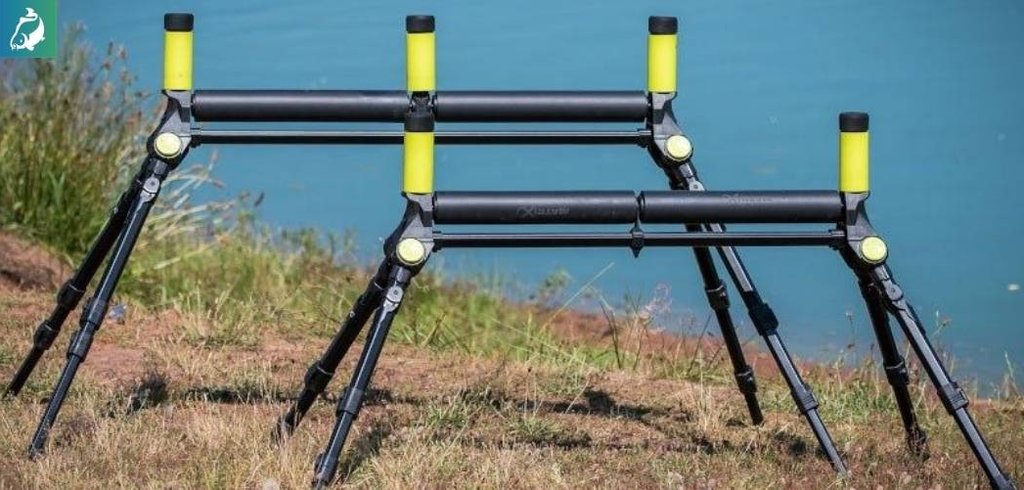
So, you've gone the whole hog and invested in a 16-metre pole?
Yep, those things can get pretty unwieldy.
The answer is a decent pole roller.
They can turn you into a pole shipping (and fish catching) machine.
In this article, we will talk you through what features to look for in the best pole rollers and even show you some great suggestions to suit all situations and budgets.
Quick Answer
The Preston Absolute Pole Roller XL is my top overall pick because it is a roller built to tackle any terrain, with an extra-wide XL base, multi-position legs and a removable central roller for shipping a long pole in two parts.
For a fraction of the money my starting point would be the Leeda Concept GT Pole Roller. The table below groups the rollers by budget, from flagship all-terrain frames down to a tough single roller.
| Rank | Best for | Pole Roller | Best suited to |
|---|---|---|---|
| Premium (£150+) | |||
| #1 | Best Overall | Preston Absolute Pole Roller XL | Serious pole anglers shipping 16-metre poles across awkward, uneven banks. |
| #2 | Top Double Roller | Daiwa Rockin Roller | Anglers on exposed, windy banks who want a double roller that resists pole lift. |
| Mid-range (£75-£140) | |||
| #3 | Most Adaptable | MAP Dual Pole Roller Mk11 | Anglers who like to reconfigure the legs and rollers to fit each peg. |
| #4 | Great Double Roller | Matrix Freeflow Mk2 Double Roller | Anglers who double-ship and need a divider to keep the two sections apart. |
| #5 | Great Value | Nytro SLS Pole Roller | Anglers wanting a spirit-levelled double roller without a premium frame's outlay. |
| Budget (under £60) | |||
| #6 | Top Simple Roller | Maver MV-R UK Pole Roller | Occasional pole anglers after simple, soft EVA protection for lighter sessions. |
| #7 | Best Budget | Leeda Concept GT Pole Roller | Anglers with a handful of sections who want a rugged, no-fuss single roller. |
What Are the Different Types of Pole Roller?
Pole rollers come in many different shapes and sizes, and there can often be a little bit of overlap. As a general rule, you'll find four different types.
Here are what they are and the advantages and disadvantages of each: -
Single Pole Rollers
Single pole rollers are the simplest type used for pole fishing. They nearly always tend to be the cheapest too. Essentially, you'll find they look like the lower three sides of a square or rectangle with a single roller at the bottom.
You'll occasionally find them mounted on a frame, but it is more common to see them screwed into a bank stick.
The upsides of single-pole rollers
- Cheap
- Easy to set up
The downside of single-pole rollers
- They are normally a small target, meaning you'll need to look back to house your pole sections.
- They aren't good for multiple sections
Double Pole Rollers
Double pole rollers are like the bigger brother of single rollers. As a general rule, you'll get more space to manoeuvre your sections as you ship in and out. Expect to see two rollers mounted on top of a flat frame with a divider in the middle.
These rollers make it easier to stay organised, plus you've got the added benefit of avoiding banging your sections together (wince).
You might occasionally see double pole rollers mounted on a bank stick. Still, it is much more common to see them as multi leg-mounted systems.
The upsides of double pole rollers
- Easy to set up and get level
- Can house multiple pole sections
The downside of double pole rollers
- Harder to transport
- They cost a little more
Flat Pole Rollers
Flat pole rollers can be either single or double. They are so-called as the main roller that supports the pole is usually mounted 'flat' in a horizontal position. They are particularly good if you will be moving and unshipping multiple pole sections.
The upsides of flat-pole rollers
- They make an easy target to hit
- Great for smooth shipping
- Good for keeping pole sections separate
The downsides of flat pole rollers
- It requires a bit of trial and error to get set up properly
V Rollers for Fishing Poles
V rollers are a little bit different. They are ok if you are only unshipping a single-pole section, but they aren't good for several sections. Ideally, you will use them as an intermediate guide or as a front pole roller.
They are brilliant for guiding large pole sections further back onto a larger roller.
The upsides of V pole rollers
- No need to get them level
- Poles stay put
The downside of V pole rollers
- Very small target
- Not suitable for multiple sections
Do You Need to Use a Pole Roller?
The truth is that unless you are using a whip or fishing with a very short pole, a good pole roller is worth every penny, and yes, you will need to use one.
Holding 5 metres of pole behind you constantly will lead to you holding 2 metres of pole eventually. Why? Your pole will break.
Pole rollers allow you to fish much more efficiently. With a little calibration and practice, they will become second nature.
Pole rollers aren't expensive, and they ultimately will prolong the life of your pole, meaning they are really cost-effective.
Want more tips on how to look after your pole? Here's a great guide on pole maintenance.
What Size Pole Roller Do You Need?
The best advice is to go for the biggest pole roller you can, especially regarding width. The bigger the roller, the bigger the target and the easier you'll find it to ship and unship your poles.
As you grow in experience, you'll also have the advantage of storing more sections, so there'll be no need to upgrade.
If you can, go for a pole roller that you can vary in height. The topography of the bank behind you will dictate how high the roller needs to be. Still, you will want flexibility if you fish in more than one venue.
The Best Pole Rollers Reviewed
Preston Absolute Pole Roller XL
#1 Best Overall
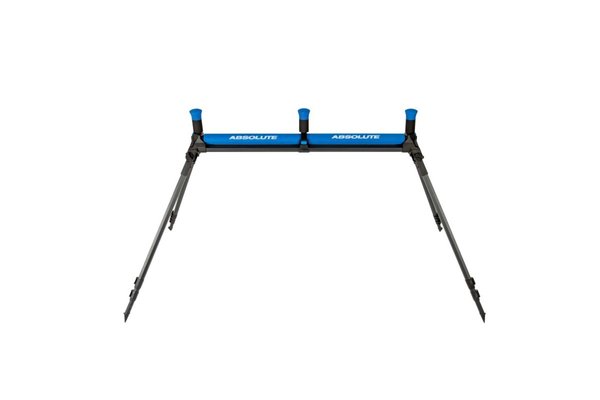
Preston built the Absolute from the ground up to cope with any terrain, and this XL version keeps that thinking while adding a much larger base to ship the pole across. It's the roller I'd back with my own money.
Every part of it is aimed at control on difficult pegs. The multi-position legs and double adjustable legs let it sit level whether the bank runs flat, sloped or stepped, and the adjustable vertical rollers guide the pole straight so the sections never fight the frame on the way back.
For me the removable central vertical roller is the detail that earns its keep. It splits the pole so it can be rolled in two parts, which keeps a 16-metre pole under control on the tightest of platforms, and it lifts straight out when it isn't needed.
At 112cm wide, adjustable from 58cm up to 149cm and 4.2kg, it's a substantial bit of kit, and the price sits at the top end to match. It arrives in a dedicated carry case, and for anyone who wants the last word in a pole roller, this is my pick of the guide.
Best suited to
Serious pole anglers shipping 16-metre poles across awkward, uneven banks.
Pros
- Extra-wide XL base for long poles
- Multi-position legs level on any terrain
- Removable central roller for split shipping
Cons
- The most expensive roller here
- Heavy and large to transport
Daiwa Rockin Roller
#2 Top Double Roller
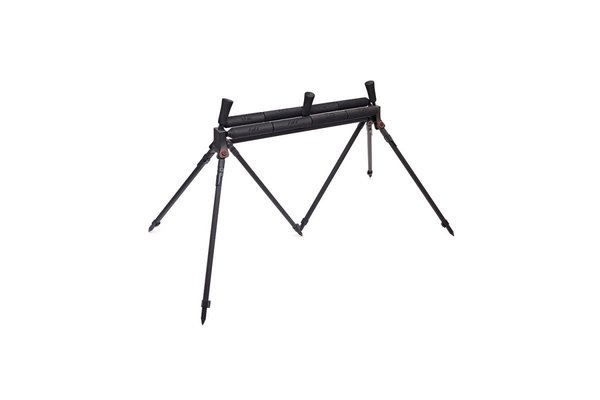
Bounce is the fault a single roller never quite shakes off, and the Rockin Roller's cure is a double layout that keeps the pole travelling on both rollers at any typical incline, looking after the sections as it goes.
The clever touches all deal with wind and awkward banks. Its two outer upright rollers sit at 20 degrees to trap the pole sections in and restrict lift on a blowy day, and they fold flat for storage, while the sliding, removable middle upright roller splits the rolling across two sides.
Stability is where it really scores. Push-button legs set at multiple positions right out to 180 degrees, or fold into the frame so it can be used at ground level, steadied by four levered ground spikes. All the rollers turn on double ball bearings and the legs are telescopic cam-lock.
The four-leg version runs at an 80cm width and raises to 89cm, while the six-leg DRR6L opens to 120cm and 135cm high for the most stable platform Daiwa make. Both come in a padded zipped carry bag, so the wind has nowhere to take the pole.
Best suited to
Anglers on exposed, windy banks who want a double roller that resists pole lift.
Pros
- Double rollers kill pole bounce
- 20-degree uprights trap sections in the wind
- Four-leg or ultra-stable six-leg option
Cons
- Six-leg version is a step up in price
- More frame to set up than a single roller
MAP Dual Pole Roller Mk11
#3 Most Adaptable
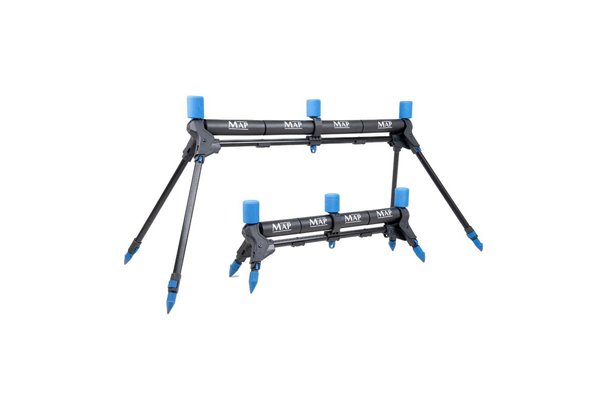
MAP took a trailblazing original and reworked every part of it for the MkII, holding on to the independent rollers, detachable central support and detachable legs while refining each one. It comes in two sizes, Medium and Large.
Those horizontal rollers are extruded from a memory-foam material that cushions the pole and, just as important, holds a consistent thickness so nothing vibrates or judders a section into bouncing on the ship. The old folding end rollers are gone, swapped for EVA rollers running on steel bearings, and the whole unit can be pulled out through a service hatch built into the frame if the worst happens.
Adaptability is the real selling point. Four independent legs pivot on steel bolts and lock both folded and spread, and a one-touch mechanism takes a stubby one-piece leg, supplied, or longer XL legs, sold separately, for high banks, each with a cam lock for height.
A steel chassis builds weight into the frame to keep it planted, with anchor points for adding more, and the detachable central roller carries a built-in spirit level plus multiple ports for extra rollers. It's a roller that reshapes itself around the peg.
Best suited to
Anglers who like to reconfigure the legs and rollers to fit each peg.
Pros
- Memory-foam rollers with no bounce
- One-touch swappable and XL legs
- Central roller with built-in spirit level
Cons
- XL legs cost extra
- More setup choices than casual anglers need
Matrix Freeflow Mk2 Double Roller
#4 Great Double Roller
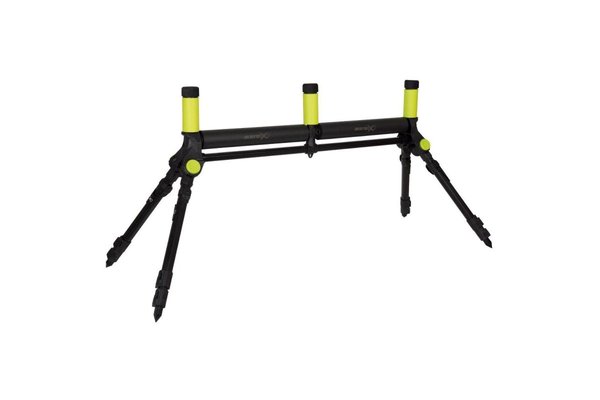
Double-shipping is where plenty of rollers come unstuck, and the Freeflow Mk2 is Matrix's answer to it. It's made in a Standard single and this Double, and the Double is the one I'd choose for anyone who ships in two parts.
Its rolling action is lovely. Extruded soft EVA rollers turn on stainless steel sealed bearings for a smooth, protective motion, and the Double carries a central divider that stops the two sections clashing together when double-shipping, which is exactly where a cheaper double falls down.
The leg system is genuinely good. Unique push-button mechanisms rotate the legs through 180 degrees and lock them in three angled positions, oversized leg extrusions add durability and stability, and mini folding leg spikes let it be used flush to the ground when needed.
At 943mm wide, 745mm at full height and 3.75kg, the Double folds into a padded carry case and takes the Freeflow leg extensions for really high banks. Foldable uprights with EVA caps round off a roller that guards the pole at every point.
Best suited to
Anglers who double-ship and need a divider to keep the two sections apart.
Pros
- Central divider for clean double-shipping
- Sealed steel bearings, very smooth
- Legs lock in three angled positions
Cons
- A double is more than single-section anglers need
- Leg extensions are an extra for high banks
Nytro SLS Pole Roller
#5 Great Value
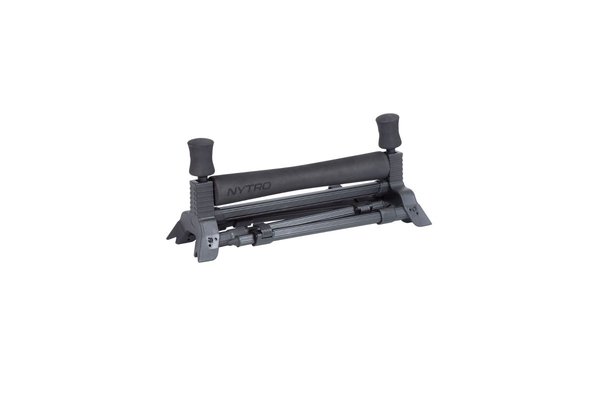
Plenty of roller for a modest outlay is what the SLS range is really about. It comes as a Double and a Single, and the Double is my pick of the two, with the Single there for anglers who ship in one piece.
That Double runs two concave, linear-designed rollers, each 30cm wide, which naturally keep the pole centred as it rolls and shield it from damage, backed by three fixed EVA uprights that suit venues where double-shipping is essential. The rolling action is genuinely silky for what it costs.
The frame does the sensible things well. Four telescopic legs allow quick height adjustment on uneven terrain, built-in spirit levels help set it dead level for real stability, and a weigh-down hook underneath lets a bag be hung to pin it against a wind.
The Single uses one 40cm concave roller on the same four-legged, double-extendable frame, which is all a lot of anglers need. Either way, this is dependable pole protection that keeps the outlay sensible.
Best suited to
Anglers wanting a spirit-levelled double roller without a premium frame's outlay.
Pros
- Concave rollers keep the pole centred
- Built-in spirit levels and weigh-down hook
- Single version for one-piece shippers
Cons
- Not as refined as the premium frames
- Three fixed uprights, less adjustable
Maver MV-R UK Pole Roller
#6 Top Simple Roller
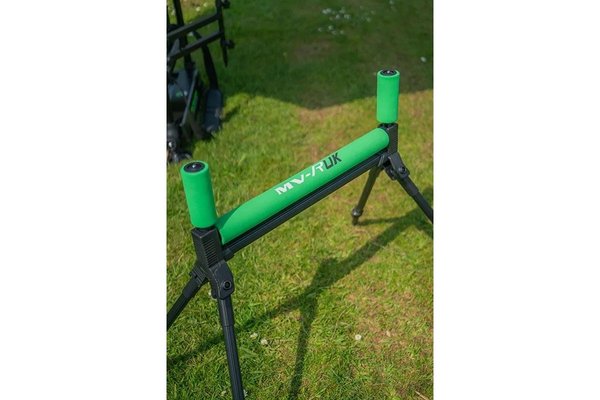
For the angler who fishes the pole now and then, the MV-R covers the basics without any fuss. Maver have kept it simple and kept it affordable.
The rolling surface uses soft-touch EVA for pole protection, so the sections are cushioned as they travel, and two end upright rollers keep the pole in line rather than letting it wander off the frame.
Setup is quick and steady. Four extendable legs, held firmly by snap-lock fittings, let it be levelled on the bank in seconds, and the whole thing packs away in the supplied carrying case.
It hasn't got the spirit levels, split-roller tricks or heavy chassis of the premium frames, so it isn't the roller for a match angler shipping a 16-metre pole all day. As a protective, easy roller for lighter use, it does the job well.
Best suited to
Occasional pole anglers after simple, soft EVA protection for lighter sessions.
Pros
- Soft-touch EVA protects the sections
- Snap-lock extendable legs, quick to level
- Carry case included
Cons
- Basic compared with premium frames
- No spirit level or split-roller option
Leeda Concept GT Pole Roller
#7 Best Budget
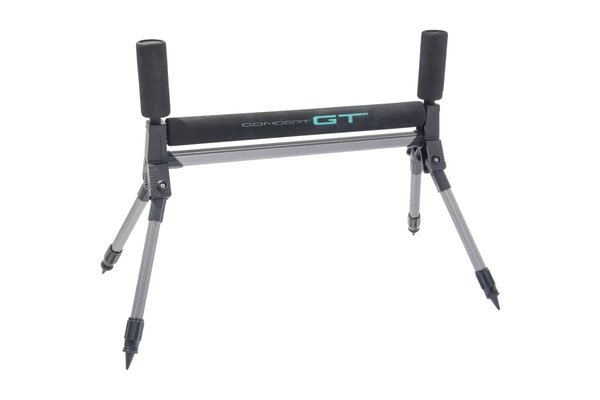
Solid, stout and chunky sums the Concept GT up. It's a little tank of a roller, practically bulletproof, and it carries over from the guide's original line-up as the budget pick for good reason.
It couldn't be simpler to use. The single foam roller comes out of the bag, unfolds and is ready to fish, with a super-smooth rolling action that belies its modest price and four lockable telescopic legs that keep it light and stable on the bank.
There's one honest catch. For such a large roller it's a shame it isn't a double, so an angler shipping a lot of sections can get a slight conveyor-belt effect where the roller nudges the previous section off.
That aside, for anyone who doesn't ship too many sections and wants a rugged roller that simply works, the Concept GT is hard to fault and harder still to wear out.
Best suited to
Anglers with a handful of sections who want a rugged, no-fuss single roller.
Pros
- Tough, near-bulletproof build
- Lightweight and stable, super-smooth action
- Cheapest roller in the guide
Cons
- Single roller, not a double
- Can shuffle sections when double-shipping
Pole Roller FAQs
Still choosing a pole roller?
These are the questions I would settle before buying.
What is the difference between a single and a double pole roller?
A single roller has one rolling surface and suits anglers who ship the pole in one piece; it is simpler and cheaper, like the Leeda Concept GT. A double roller, such as the Daiwa Rockin Roller or Matrix Freeflow Double, has two surfaces so the pole can be split and rolled in two parts, which keeps a long pole under control on a tight platform and cuts out bounce.
Anglers fishing 14.5m and 16m poles usually prefer a double.
What size pole roller is needed?
It depends on how long the pole is and how far back it has to go. A wider frame like the Preston Absolute XL, at 112cm, supports more of the pole and makes shipping a 16m pole steadier, while a compact roller is fine for shorter margin poles.
The key is that the pole should meet the roller squarely and stay supported through the whole shipping stroke.
Do pole rollers need spirit levels and ground spikes?
They are a real help on awkward banks. Built-in spirit levels, as on the Nytro SLS, take the guesswork out of getting the roller dead level, and ground spikes or a weigh-down hook pin it in place so a gust does not lift the pole. On a flat, firm platform they matter less.
How does a pole roller protect the pole?
It keeps the sections off the ground and rolling on a soft surface rather than dragging over grass, gravel or a hard platform. Soft EVA or memory-foam rollers, as used across this guide, cushion the carbon, and angled uprights stop the pole lifting off in the wind, all of which spares expensive sections from scratches and cracks.
Final Thoughts
The function of a decent pole roller is twofold. They protect your poles and keep them off the ground. They also make shipping so much easier.
Try and pick something easy to see, and more importantly, easy to use that will allow you to fish in various locations.
Poles aren't always expensive, but you will still want to look after them!
If you want to know more about poles and the best brands, check this out.
Thanks for reading.
Related Articles...

5 Best fishing poles under £500
In this article we are going to have a quick run through what pole fishing is all about and give you some suggestions on the best fishing poles under £500 today.

Best Poles for Margin Fishing
This article aims to provide you with a complete guide to the best poles for margin fishing and should hopefully help you choose the right margin pole for your specific circumstances.

6 Best Fishing Poles for Beginners
This article seeks to provide some clarity on the basics of a fishing pole and the different types available in order to help decide on the best fishing poles for beginners.