
The Best Fishing Crimping Tools for 2026
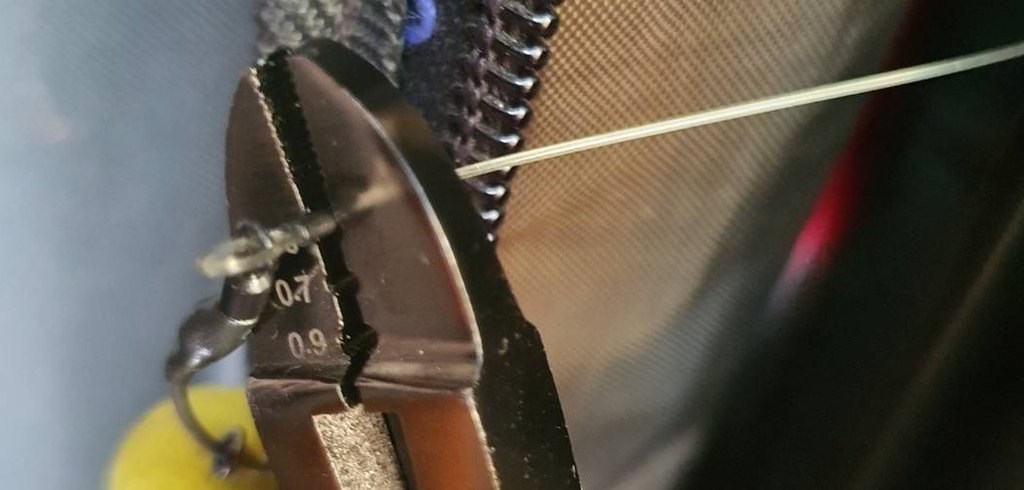
A crimping tool can be a useful addition to your fishing tackle inventory, especially with rig tying. I have been using them a lot recently with my carp fishing and have found that they really help with the speed and efficiency of tying rigs.
In this article, I will take you through what I consider the best fishing crimping tool on the market and how I use it to improve my fishing.
If you are in a hurry and wish to jump straight to my recommended fishing crimping tool, you can do so below.
Quick Answer
The Gardner Crimpit Tool is my top overall pick because it is a complete kit, arriving with two crimp sizes and a built-in cutting edge, so a rig can be built start to finish from one purchase.
For the least money my starting point would be the Drennan E-SOX Crimping Pliers. The table below sorts the tools by the job they do best, from carp-rig crimping to predator wire traces.
| Rank | Best for | Tool | Best suited to |
|---|---|---|---|
| #1 | Best Overall | Gardner Crimpit Tool | Carp anglers who want the tool, both crimp sizes and a cutter in one box with nothing else to chase. |
| #2 | Top Loaded Bundle | RidgeMonkey Nite-Glo Crimp Tool | Carp anglers tying rigs after dark who want crimps and covers loaded in alongside the tool. |
| #3 | Top for Predator Wire | Fox Rage Crimping Pliers | Predator anglers who want crimps closed smooth so nothing sharp is left on a finished trace. |
| #4 | Great Predator Tool | PikePro Crimp Tool | Pike anglers who want toothed jaws biting into the crimp rather than flattening it whole. |
| #5 | Great Wire Crimper | Daiwa Prorex Crimping Pliers | Trace-makers who want the crimp edge kept off the steel wire rather than nipped into it. |
| #6 | Great for Carp Rigs | Wychwood Crimping Tool | Carp anglers matching crimp size to line diameter across stiff materials and heavy mono. |
| #7 | Best Budget | Drennan E-SOX Crimping Pliers | Predator anglers who want the crimp located by the tool rather than lined up by eye. |
Why Use A Fishing Crimping Tool?
In modern-day carp fishing, there are many new rigs that have proven to be extremely effective in catching carp. The spinner rig (sometimes called the Ronnie Rig) is one particular example that I have personally caught a lot of carp with. When this rig is fished in conjunction with a helicopter set-up, you can fish confidently, knowing that tangles are virtually eliminated and that your carp bait will sit on top of the lake bed no matter the contours and makeup.
When tying this rig, the tool I use most is the crimping tool. Crimps limit the number of fiddly knots being tied. This in turn limits damage to your reel line that tying knots can cause. They can also strengthen your setup, for example, if you accidentally tie a poor knot, you can create a weak link in your rig that can cause crack-offs. Using crimps eliminates this risk.
I also use a fishing crimping tool to take off unnecessary components on items such as ring swivels to minimise the amount of metal that makes up the rig. A good fishing crimping tool will come with additional features such as plier-type jaws that can achieve this sort of job with ease.
Other rigs I use a fishing crimping tool with include the chod rig, the stiff hinge rig and for tying stiff booms.
Check out this great video from Korda fishing that shows a crimping tool in action to tie a spinner rig.
What Features To Look For In A Crimping Tool For Fishing
The best fishing crimping tools do more than just secure crimps to line or leaders. Quite often, they have bolt-on tools that perform other useful tasks when tying rigs. A decent crimping tool will also be well-designed to suit an angler’s needs. Let’s go through some of the features to look out for.
Size
The majority of carp anglers take everything (including the kitchen sink) with them on a session. The amount of times I’ve seen anglers with sweat pouring from them as they make their way to their swim with the carp barrow creaking with the amount of gear on it is unreal!
So when there’s an opportunity to limit the size and weight of a piece of tackle, it can only be a good thing.
A crimping tool doesn’t have to be big for fishing. It needs to be small, compact and fit into your tackle box easily. As long as it fits in your hand and you can use it effectively then it’s big enough.
Handle
To be able to use a crimping tool effectively for fishing, then you need to be able to grip the tool and use it comfortably. The handle of a good crimping tool for fishing should be made of a comfortable material that is easy to hold (even when wet) and fit the natural contours of your hand perfectly.
The Spring Mechanism
By the spring mechanism, I mean the way by which the tool closes and then opens again. If closing the crimping tool is stiff and hard work then it is no good. Likewise, if it’s too loose and wobbles then you may have to use more pressure than is comfortable to do so for the tool to do its job.
The best crimping tools for fishing allow just a slight amount of pressure with your fingers to be able to apply the required amount of force to secure the crimp onto your fishing line.
Crimp Size
Depending on the rig you are using and indeed the diameter of line you are tying will depend on what crimp size you will need. The most common size crimps that are used for tying carp fishing rigs are 0.6mm, 0.7mm and 0.9mm.
With this in mind, the best crimping tools for carp fishing should have different-sized crimp moulds on them that fit the required sizes. Tools with just one crimp size that is marketed as ‘one size fits all’ should be avoided.
Check out the following table that gives a general guide on what crimp size is suitable for what rig:
| Crimp Size (mm) | Suitable Rig |
|---|---|
| 0.6 | Normal stiff materials such as Amnesia |
| 0.7 | Thick hook lengths such as 25lb stiff bristle filament |
| 0.9 | Perfect for 30lb+ monofilament |
Additional Tools
As mentioned earlier, the better crimping tools for angling have some handy bolt-ons with them. Some examples of these include:
- Plier-like serrated edges
- A cutting tool
- A hole to help hold a carp hook in place
- Reinforced material used for strength
The Best Fishing Crimping Tools Reviewed
Gardner Crimpit Tool
#1 Best Overall
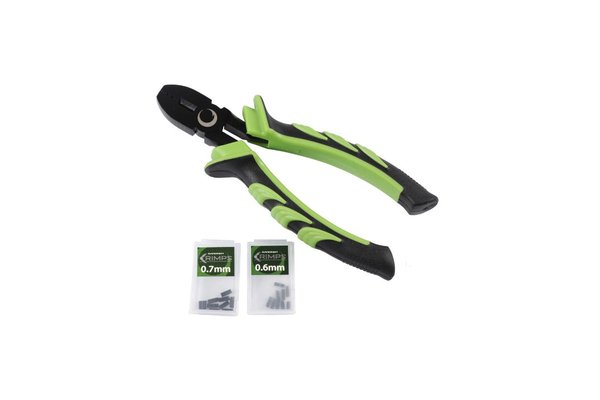
Most crimping tools turn up as a bare pair of jaws and leave the crimps as a separate errand. The Gardner Crimpit doesn't, and that's the single reason it heads this guide: it's sold as a set, so a rig can be built the evening it lands.
This is firmly the carp half of the guide. Gardner pitch crimping as a way to tidy and slimline a rig, doing away with large bulky knots and replacing them with a stronger, more rigid crimp, and they list the tool for booms, chod rigs and much more. That's the work it's cut out for. An angler making up wire pike traces wants one of the predator pliers further down instead.
The kit runs to ten 0.6mm crimps and ten 0.7mm, so there are two sizes in the box rather than the one-size-fits-all approach the buying guide above warns anglers off. A side cutter is built in, which Gardner rate for trimming large diameter lines and swivels, and there are large grips to lean on while the crimp closes.
The honest catch is where those sizes stop. Nothing in the box goes past 0.7mm, so an angler working 30lb-plus mono is out of range and would be better served by the Wychwood and its 0.9mm. Ten of each crimp is a starter's worth rather than a season's, and none of it is any use on wire.
Best suited to
Carp anglers who want the tool, both crimp sizes and a cutter in one box with nothing else to chase.
Pros
- Ten each of 0.6mm and 0.7mm crimps included
- Side cutter for large diameter lines and swivels
- Large grips to close the crimp on
Cons
- Nothing larger than 0.7mm in the set
- A carp-rig tool, no use on wire traces
RidgeMonkey Nite-Glo Crimp Tool
#2 Top Loaded Bundle
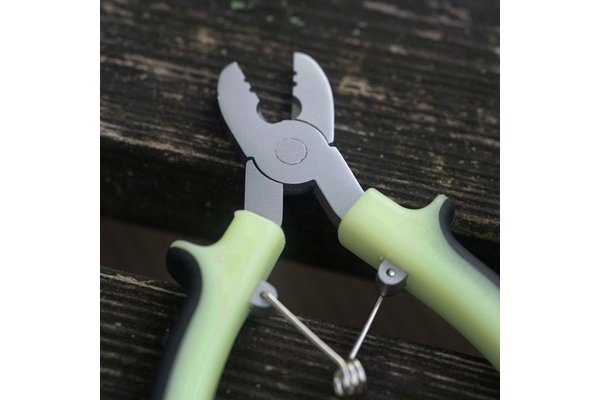
Losing a small tool in wet grass at two in the morning is a fishing rite of passage. RidgeMonkey's answer is handles that glow brightly in the dark so the thing can be located again in low light, and between that and how much is loaded into the box, it earns its slot.
It arrives as a bundle: the Nite Glo tool, ten 0.6mm crimps, ten 0.7mm, and ten Rock Bottom Crimp and Knot covers, which RidgeMonkey say is everything needed to construct strong, neat loops for hooklinks and booms. The covers are tungsten, and that added weight helps sink and pin a rig down.
The method stays simple even by torchlight: slide the line through the crimp, feed it back through the other hole to leave the loop at the length wanted, line the crimp up with the right notch and squeeze. Two differently sized notches crimp 0.6mm and 0.7mm laterally, there's a line cutter in the jaws, and a locking clasp swings over to hold them shut. The overmoulded grip on the slimline handles is what lets the pressure go in without the tool slipping, and at 125mm long and 70g it lives in a tackle box without argument. RidgeMonkey flag it as particularly useful for stiff filaments and for rig making with dexterity constraints.
Two notches is the ceiling, same as the Gardner, so heavier mono past 0.7mm isn't catered for at all. The covers are RidgeMonkey's own, which is fine until an angler who already keeps crimps and covers finds half the bundle duplicating the tackle box. It's carp rig kit start to finish, so wire traces are the wrong errand for it.
Best suited to
Carp anglers tying rigs after dark who want crimps and covers loaded in alongside the tool.
Pros
- Handles glow for locating it in low light
- Crimps and tungsten Rock Bottom covers included
- Line cutter and locking clasp in the jaws
Cons
- Notches stop at 0.7mm
- Half the bundle may duplicate kit already owned
Fox Rage Crimping Pliers
#3 Top for Predator Wire
A crimp with a sharp edge left on it is a trace that catches the net, and worse, a joint with a stress point built into it. Fox Rage designed these to compress crimps without stress or creating sharp edges, and that one line is what puts them at the top of the predator half of this guide.
So this is the wire side, not the carp side. Fox Rage describe it plainly as the tool for creating strong crimped connections on traces, which means pike and lure work. An angler after chod rigs and booms should be looking at the Gardner or the Wychwood instead, and getting that the wrong way round is an easy mistake to make and an annoying one to discover at the water.
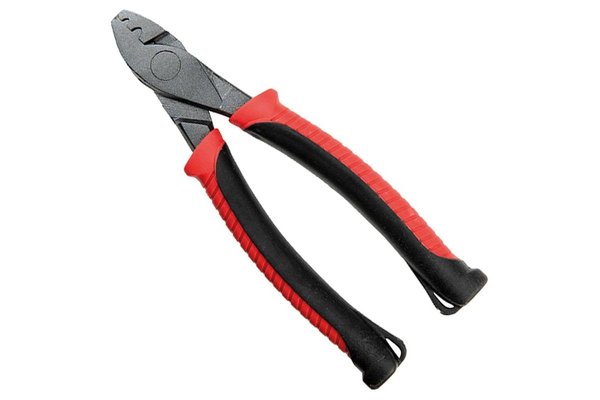
The build is honest enough: high-quality carbon steel under a gunmetal grey finish, with ergonomic hard plastic handles done in easy-find bright red and black. That last bit sounds like marketing and isn't. A dark tool in a dark lure box is a tool I'll spend five minutes hunting for.
The catch is what the listing doesn't say. It names no crimp sizes and no separate sections, so unlike the Daiwa or the Drennan below there's nothing stated about matching a crimp to the jaws, which is precisely the sizing question the buying guide above tells anglers to ask. It's a plier for traces and nothing else, so it belongs in a predator bag rather than a carp one.
Best suited to
Predator anglers who want crimps closed smooth so nothing sharp is left on a finished trace.
Pros
- Compresses crimps without leaving sharp edges
- Carbon steel with a gunmetal grey finish
- Bright red and black handles are easy to find
Cons
- Listing names no crimp sizes or sections
- A trace tool, wrong for carp rigs
PikePro Crimp Tool
#4 Great Predator Tool
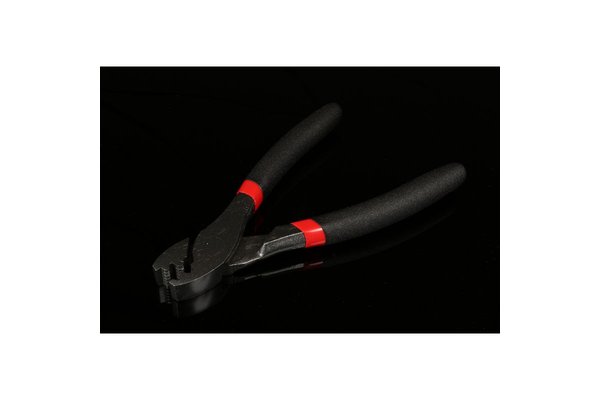
There's more than one way to shut a crimp, and PikePro's is the one that convinces me most. Rather than squashing the barrel flat along its length, the toothed jaws press a series of indentations into it as it compresses.
PikePro's argument is that those indentations grip the wire inside much more securely than compressing the whole crimp does, and having knocked up a few traces that way, the joint does come out neat rather than mangled. The tool is designed specifically for single-barrel crimps, and for creating a strong, neat joint with the PikePro wire range.
All of which places it squarely in predator territory: wire traces for pike and lure fishing, a long way from the carp tools at the top of this guide. Extra-strong steel construction is what PikePro credit for a perfect finish every time with minimal effort, and the non-slip handles count for more than they sound like when there's a batch of traces to work through and the hand is starting to complain.
Against that, it's a tool with strong opinions about company. Built around single-barrel crimps and PikePro's own wire, it works as part of a system rather than as an all-rounder, and the listing puts no sizes to the jaws at all. It does exactly one job, too: nobody is closing a 0.7mm carp crimp with it.
Best suited to
Pike anglers who want toothed jaws biting into the crimp rather than flattening it whole.
Pros
- Toothed jaws indent the crimp rather than flatten it
- Made for single-barrel crimps and PikePro wire
- Non-slip handles, minimal effort per crimp
Cons
- Built around PikePro crimps and wire
- Single-barrel crimps only, no carp use
Daiwa Prorex Crimping Pliers
#5 Great Wire Crimper
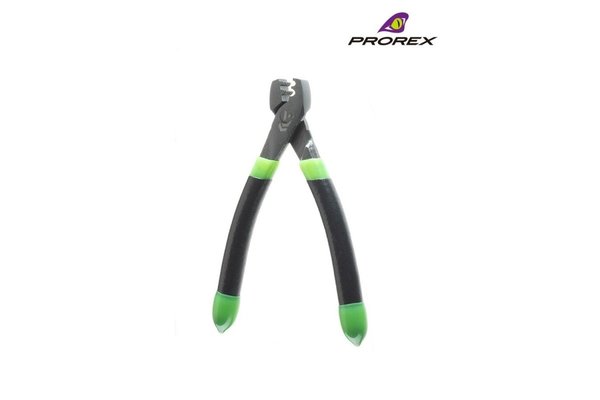
A trace rarely lets go in the middle of a crimp. It goes at the edge, where the metal meets the wire, and the Daiwa Prorex pliers are built around that specific problem.
Five pressure points sit at the jaws, and Daiwa's claim is that they guarantee an optimal crimping while preventing damage to the steel wire at the crimp edge. Steel wire is the giveaway here: this is a predator trace tool for pike and lure work, and an angler holding a chod rig wants one of the carp tools higher up the guide instead.
Two sections take differently sized crimps, which clears the bar the buying guide above sets out. A single one-size-fits-all jaw is the thing to steer clear of, and two sections at least means matching a crimp to a section rather than hoping. Daiwa call it a premium plier, the body measures 5.5 inches, and both handle ends are marked with self-luminous material, which does the sensible thing of making the pliers findable in the dark rather than promising anything cleverer than that.
Two sections is still only two, mind, so this isn't the tool for an angler running a wide spread of crimp sizes. Daiwa's listing is also thin beyond the jaws: there's little said about the handles or how much pressure it takes to close them, which the buying guide rates as one of the three things worth knowing. Carp anglers can skip it entirely.
Best suited to
Trace-makers who want the crimp edge kept off the steel wire rather than nipped into it.
Pros
- Five pressure points spread the load at the jaws
- Two sections for differently sized crimps
- Self-luminous ends on both handles
Cons
- Only two crimp sections
- A steel wire tool, not for carp crimps
Wychwood Crimping Tool
#6 Great for Carp Rigs
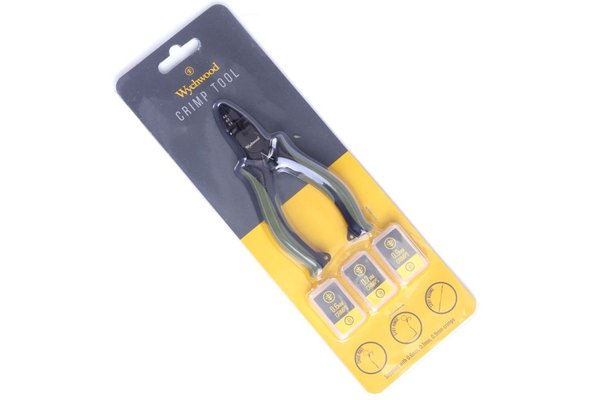
Three crimp sizes, not two. That is the plain reason the Wychwood tool sits in this guide, and on the buying guide's own crimp-size test it's the one that goes furthest of the lot.
Wychwood reckon they were the original innovators who brought this method to market, and with the spread of materials now used for hook lengths they redesigned the tool to suit the modern angler. Their case for crimping in the first place is a sound one: rigs built to the perfect length without tying fiddly knots, and less of the line damage that comes with tightening knots down in heavy lines.
The sizing detail is what earns it the slot. It's supplied with 0.6mm, 0.7mm and 0.9mm crimps, and Wychwood spell out what each is for: the line should just fit into the hole, 0.6mm suits normal stiff materials like amnesia, 0.7mm is for thicker types such as 25lb stiff bristle filament, and 0.9mm handles 30lb-plus mono. The jaws are made specifically for closing carp crimps and flare the crimp at the edges to prevent damage to the line, they're stainless steel for strength, a side cutter is included, and the whole thing is sized to fit most tackle boxes.
The flip side of three sizes is three decisions, and a crimp a size out is a crimp wasted, so this one rewards an angler who checks line diameter rather than eyeing it. It's carp through and through as well: those jaws are cut for carp crimps, and a pike angler with a spool of wire needs the predator pliers in the other half of this guide.
Best suited to
Carp anglers matching crimp size to line diameter across stiff materials and heavy mono.
Pros
- Supplied with 0.6mm, 0.7mm and 0.9mm crimps
- Jaws flare the crimp edge to protect the line
- Side cutter, and sized to fit most tackle boxes
Cons
- Three sizes means checking line diameter carefully
- Carp crimps only, no wire trace use
Drennan E-SOX Crimping Pliers
#7 Best Budget
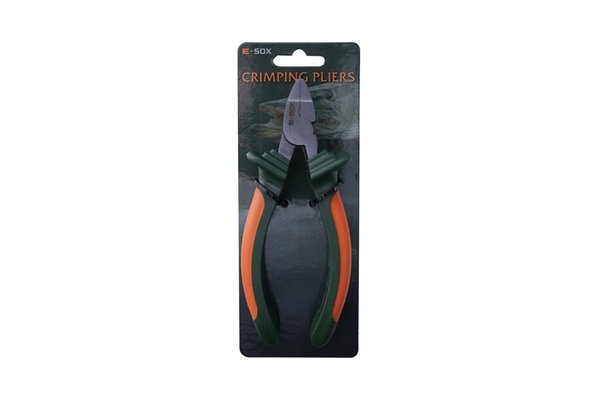
Getting a crimp sat square in the jaws by feel is the bit that quietly goes wrong, usually on the trace that then lets go. Drennan's fix is mechanical rather than clever: slots cut to locate the crimp so it can only sit where it should.
Those slots are designed to locate E-SOX Slim Crimps for perfectly crimped traces, and Drennan's claim for them is the one that actually matters on wire, that it ensures the maximum wire breaking strain is achieved. A crimp is only worth doing if the joint holds what the wire holds. E-SOX is Drennan's predator range and traces are the job here, so a carp angler after a chod or a boom is reading the wrong half of the guide.
Two sizes of slot take different crimps, which clears the one-size-fits-all bar the buying guide sets out above. Construction is high carbon steel under a matt black PTFE finish, with a comfortable twin colour handle. For a tool this pared back, there's nothing on it that feels like it was added to fill out a bullet list.
The slots giveth and taketh away, though. They're cut for E-SOX Slim Crimps, so this sits happiest inside Drennan's own system, and another brand's crimps may not seat as cleanly. Two slots is a narrow spread next to the Wychwood and its three sizes, and it's wire only, so it does nothing whatsoever for a carp angler.
Best suited to
Predator anglers who want the crimp located by the tool rather than lined up by eye.
Pros
- Slots seat the crimp squarely every time
- High carbon steel with a matt black PTFE finish
- Two slot sizes for different crimps
Cons
- Slots are cut for E-SOX Slim Crimps
- Wire traces only, nothing for carp rigs
Fishing Crimping Tool FAQs
Still choosing a tool?
These are the questions I would settle before buying.
Why use a crimping tool for fishing?
Crimping lets a rig or trace be built to an exact length without bulky knots, replacing them with a stronger, more rigid connection. It is the standard way to finish wire pike traces, which do not take a knot the way mono does, and it suits stiff carp hooklinks and booms too: Wychwood point out that it cuts the line damage that comes from tightening knots down in heavy lines.
What should I look for in a crimping tool?
Jaws that form the crimp without creating sharp edges or damaging the wire, so the connection keeps its full breaking strain, matter most. Slots or sections sized to the crimps in use help, as on the Drennan and Daiwa tools, and a cutting edge or included crimps, like the Gardner Crimpit, add convenience.
What size crimps do I need?
Match the crimp to the line diameter, and the line should just fit into the hole. Wychwood give the clearest steer of anyone here: 0.6mm for normal stiff materials like amnesia, 0.7mm for thicker types such as 25lb stiff bristle filament, and 0.9mm for 30lb-plus mono. The Gardner and RidgeMonkey tools cover 0.6mm and 0.7mm, while predator wire uses single-barrel crimps sized to the trace wire instead.
Are crimped connections stronger than knots?
On the right material, yes. Wire traces and stiff coated hooklinks hold far better crimped than knotted, and a correctly formed crimp keeps close to the full breaking strain. The key is a good tool that indents or closes the crimp cleanly, like the toothed-jaw PikePro, rather than crushing it flat.
Final Thoughts
Technology is advancing all the time and in the angling world, new and advanced rigs are being tried and tested regularly. Quite often these rigs take learnings from underwater videos whereby it is proven that wise old fish can eject a hook without you ever knowing they were there.
With the use of a fishing crimping tool, these advanced rigs are being made easier to tie and create as well as making things neater and safer with fewer knots required in the whole setup.
If you are into rig making, I thoroughly recommend you invest in one. To recap, my favourite is the Wychwood crimping tool as it has all the features I need at an excellent price. I hope this guide has helped you in deciding which one would suit you best.
Many thanks for reading.
Tight Lines!