
The Best Carp Cradles for 2026
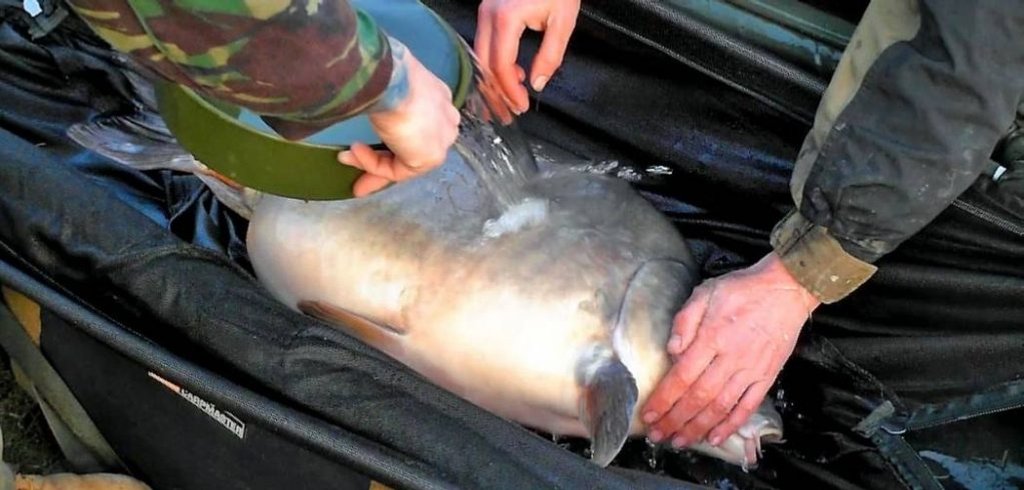
When you think of cradles the mind is probably drawn more to crying infants than fish.
But as carp anglers, we should be treating our catch with pretty much the same care and attention.
Carp are designed to be in one place and one place only, the water. When they are on dry land they are very vulnerable.
As you will undoubtedly know, carp can be extremely strong, and if one manages to thrash free of a careless grip, the damage inflicted can be fatal.
This is why you should be using the best carp cradle for the size of fish you are targeting.
Carp cradles are not created equal however and careful consideration is needed before you make your choice.
This article is going to go through some key features of the best carp cradles to help you make a more informed decision.
Quick Answer
The Trakker Sanctuary Cradle is my top overall pick because its internal cover retains water or shields the fish, the fast-drain mesh base and foam frame protect at every stage, and it even includes a carp care guide.
For less money my starting point would be the NGT Quickfish Cradle. The table below groups the cradles by budget, from complete fish-care stations down to an instant-setup bargain.
| Rank | Best for | Cradle | Best suited to |
|---|---|---|---|
| Premium (£95+) | |||
| #1 | Best Overall | Trakker Sanctuary Cradle | Anglers who want the most complete fish-care package in the guide. |
| #2 | Top Water-Retention Design | Nash Hi-Protect Carp Cradle | Anglers who fish waters with differing rules on wet versus draining cradles. |
| #3 | Great Low-Level Design | Avid Pro-Tect Safeguard Cradle | Anglers who want fish lifted the shortest possible distance at every stage. |
| #4 | Top Quick Setup | Solar SP C-Tech Quick Up Cradle | Anglers who want the cradle standing ready in seconds, not minutes. |
| Mid-range (£50-£60) | |||
| #5 | Great for Mobile Anglers | Sonik Xtractor Folding Cradle | Roving anglers who want a floating cradle that halves in size and carries kit. |
| #6 | Great Value | Leeda Rogue Carp Cradle | Anglers who want frame-and-hammock fish protection without the premium spend. |
| Budget (under £50) | |||
| #7 | Best Budget | NGT Quickfish Cradle | Anglers after the cheapest genuine cradle that sets up instantly. |
What Is A Carp Cradle Used For?
Carp cradles are used immediately after you have the fish safely in the landing net and they ultimately provide a handy safe surface to unhook and hopefully (if big enough) weigh your catch on a decent set of fishing scales.
They are made in such a way that they are fairly portable and waterproof. The best carp cradles will adequately support fish up to pretty much any size.
A decent cradle should also be big enough and protective enough to be able to confidently lift a fish when posing for a camera take and if the worst possible situation happens of the fish escaping your clasp, the cradle will protect the fish from any major damage.

The Features Of The Best Carp Cradles
First and foremost, when looking at a carp fishing cradle, you should ask yourself the following question; Will this fishing cradle keep the fish safe and comfortable?
If the answer is ‘no’ then it is time to move on. Key features that will keep a fish safe are a soft fish friendly surface. Anything that will catch a fin or damage a carp’s delicate body should be avoided.
The fishing cradle should also adequately support the weight of the fish, across the entire length of its body.
There should be no pressure points on the fish whatsoever. This is normally achieved with carp cradles by utilising the same concept as a hammock, or a bed. It is worth considering what type of terrain you normally fish on.
Some carp fishing cradles utilise a frame, which may not be the most stable if you are fishing on a steep bank or rocky terrain. In this case, you may be better off going for a ‘bed’ style carp fishing cradle.
The best carp cradles also have walls to prevent an inadvertent escape by an energetic or lively fish. Whilst carp tend to be pretty sedate once they are landed, it pays dividends to avoid taking any chances, it only takes one drop for a fish to be critically injured.
Now that we have looked at the safety aspect, let's delve a little deeper and look at things that make a good carp cradle into the best carp cradle.
A carp cradle is a little bit of a barrier to being mobile, however, if you are going to carry one round then it makes sense to make it as light as possible (whilst still bearing in mind the above points of course).
There are several solutions to ensure a little mobility and ease of portability with fishing carp cradles. This normally comes in the form of being able to fold the cradle and stow it in a smaller size when it is not in use.

If you are using them correctly, carp fishing cradles will be in constant contact with the fish. As a result water, from the swim and maybe some residue from the fish may rub off onto the cradle.
If left to stand you can imagine what the result will be. Therefore drainage and ease of cleaning is another feature you want to be on the lookout for.
As an additional bonus, drainage holes allow you to pour water on the fish whilst it is in the cradle, which will keep it cool and probably in a little better mood.
By being waterproof many carp fishing cradles afford the angler the option of being able to submerge the cradle in the water meaning that the carp will never need to be picked up by hand.
Whilst this might look good for a photo opportunity, with particularly heavy fish the weight of your hands can create pressure on their body and ideally should be avoided.
Here's an example of how easy carp fishing cradles are to use:
The Best Carp Cradles Reviewed
Trakker Sanctuary Cradle
#1 Best Overall
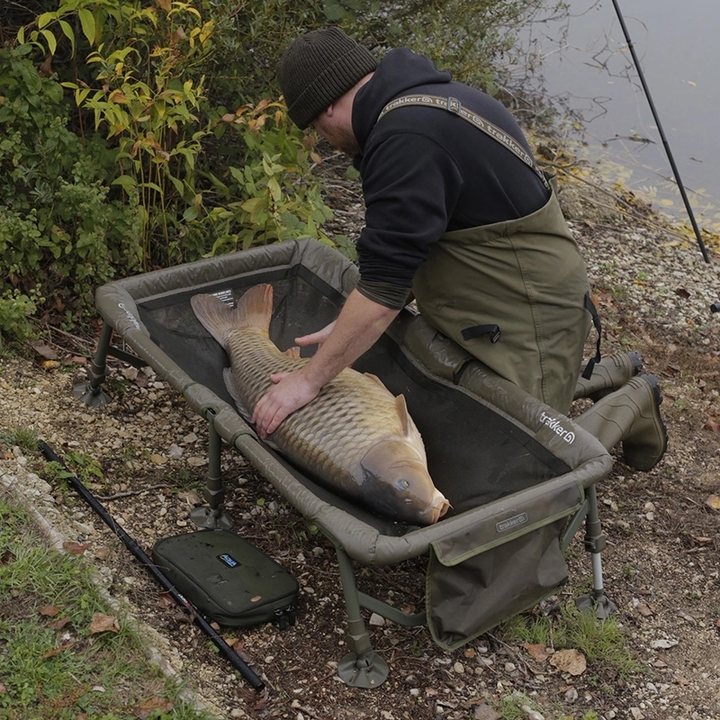
The Sanctuary takes the top spot because it treats fish care as a system rather than a padded tray. The rugged 420D PVC build is fish-friendly and easy to clean, and the solid internal cover works two jobs: retaining water in the cradle so the fish sits in a calm pool, or covering the fish to keep sun and stress off it.
The base is full fast-drain mesh, the same fabric as Trakker's Sanctuary Retention Sling V2, so water empties quickly when it needs to, while a high-density foam frame wraps the fish in protection.
The bankside practicality is equally thorough: six height-adjustable legs with rotating mud feet and locking pins keep it level and stable on any terrain, a large pocket stores scales and carp-care essentials, a rubber Carp Care Guide comes included, and the whole thing sets up fast then folds flat into its supplied carry bag. It measures 120cm by 60cm and weighs 6.75kg.
Nearly seven kilos is a real carry for a roaming angler, and it costs proper money. As the complete fish-care station for session anglers, it's the standard-setter.
Best suited to
Anglers who want the most complete fish-care package in the guide.
Pros
- Cover retains water or shields the fish
- Fast-drain mesh base, foam frame
- Six adjustable legs with mud feet and lock pins
Cons
- Heavy at 6.75kg
- Premium price
Nash Hi-Protect Carp Cradle
#2 Top Water-Retention Design
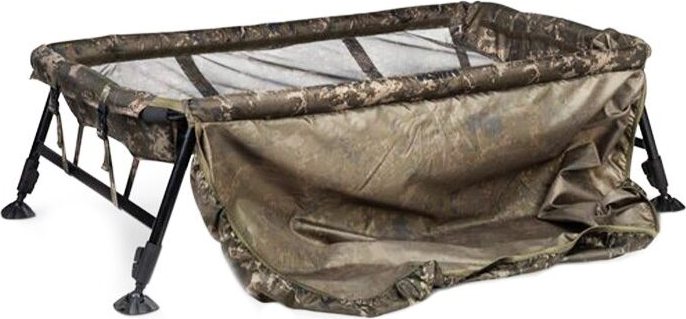
The Hi-Protect solves a problem session anglers actually meet: some fisheries demand a draining cradle, others want water retained. Nash's answer is a free-draining mesh base with a Velcro-secured 210D nylon water retention panel that goes in or comes out in seconds.
The other clever bit is the extended leg adjustment. Set low it keeps carp close to the ground the traditional way, and raised it lets an angler sit with legs beneath the cradle and hold a big carp directly over cradle and lap, sparing the back that lifting heavy fish punishes.
Protection is continuous rather than patchy, with a fully padded hi-protect frame, buckle-and-webbing tension holding the cradle's shape, and an elasticated retention flap that secures around the frame. It folds flat and clips together for transport, with mud feet on the legs.
It's the dearest cradle in the guide and the camo finish is the only option here. As the most adaptable premium cradle, it justifies the extra over the Sanctuary for rule-hopping anglers.
Best suited to
Anglers who fish waters with differing rules on wet versus draining cradles.
Pros
- Removable water-retention panel in seconds
- Raised mode saves the back with big fish
- Continuously padded frame with tension straps
Cons
- Dearest cradle here
- Camo only
Avid Pro-Tect Safeguard Cradle
#3 Great Low-Level Design
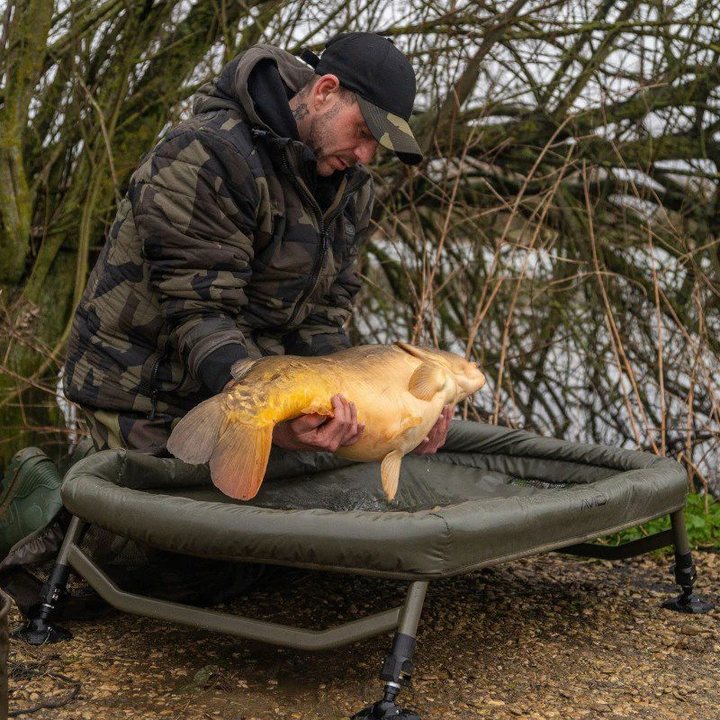
The Pro-Tect Safeguard is designed around one principle: the less height a fish travels, the safer it is. The low-to-ground frame and shallow mattress make lifting fish in and out as easy as a cradle allows.
Everything else serves safe unhooking, handling and photography. The oval frame carries generous padding, a camo pullover retention flap adds security when the fish needs a moment covered, and mesh drainage grids at both ends dump water quickly.
The build details hold up: a robust fish-friendly fabric that Avid state won't delaminate, four adjustable legs for uneven ground with large rotating mud feet for stability, a folding frame and legs for transport, and a heavy-duty carry bag included. It's 126cm by 70cm, standing 26cm to 35cm, at 6.9kg.
It's marginally the heaviest cradle here and the low stance suits ground-level handling more than standing work. As the safe-handling specialist, it's a superb piece of kit.
Best suited to
Anglers who want fish lifted the shortest possible distance at every stage.
Pros
- Low frame and shallow mattress for easy lifting
- Generously padded oval frame
- Drainage grids at both ends
Cons
- Heaviest cradle in the guide
- Low stance suits kneeling anglers
Solar SP C-Tech Quick Up Cradle
#4 Top Quick Setup
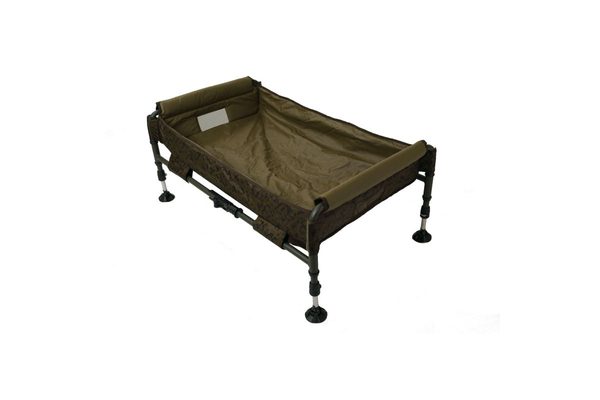
The Quick Up earns its name: Solar's exclusive knuckle frame design unfolds or packs the cradle away in seconds, which matters most in the moment a fish is waiting in the net and every second of setup is a second of stress.
The fish-care fundamentals are properly covered, with a water-resistant blackout elasticated folding cover that prevents escapes and shields from sun or rain, two rubberised mesh vents for rapid water drainage, and a PVC-lined inner base that resists saturation and smells and wipes clean.
The frame is reinforced steel for long-term strength, the four legs adjust 50mm each for stability on uneven ground, and it comes in Standard and XL sizes with a 600D camo carry bag styled to match the rest of the SP C-Tech range, including the rod holdall in our holdall guide.
Steel makes it sturdy rather than featherweight, and the XL costs more than the price shown. As the fastest cradle here to deploy, it's the roving-session premium pick.
Best suited to
Anglers who want the cradle standing ready in seconds, not minutes.
Pros
- Quick Up knuckle frame deploys in seconds
- Blackout cover calms and secures fish
- Steel frame, Standard and XL sizes
Cons
- Steel build carries some weight
- XL size costs extra
Sonik Xtractor Folding Cradle
#5 Great for Mobile Anglers
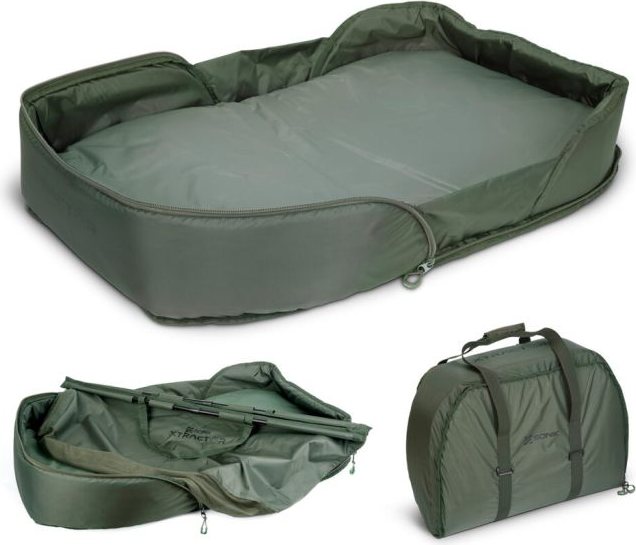
The Xtractor is the mobile answer, a frameless cradle built from 50mm dual-density foam that folds in half with a security zip to halve its size, then earns its carry twice over by doubling as a stalking bag with kit stowed in the inner chamber.
The PVC-coated base gives it a trick the framed cradles can't match: it floats, so photographing or recovering a fish in the water's edge happens with the cradle right there in the margins.
Fish protection comes from the semi-rigid padded walls around a fish-friendly inner chamber, and it suits carp and specialist anglers on stillwaters and rivers alike. Side buckles attach it to the Xtractor rucksack and side handles make the carry easy.
Without legs or a frame it works at ground level only, and it lacks the covers and drainage systems of the premium picks. As a floating, folding cradle for the mobile school, it's cleverly judged.
Best suited to
Roving anglers who want a floating cradle that halves in size and carries kit.
Pros
- Floats for waterside photos and returns
- Folds in half, doubles as a stalking bag
- Semi-rigid padded walls
Cons
- No legs or frame
- No cover or drainage system
Leeda Rogue Carp Cradle
#6 Great Value
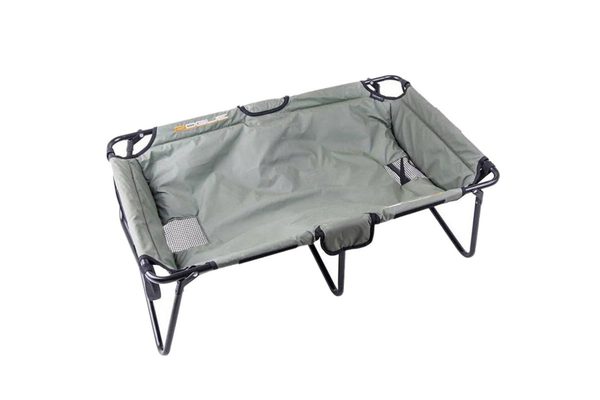
The Rogue carried over from this guide's original line-up, where it held the budget slot, and its hammock-style design is still the reason to buy it: the frame suspends the fish inside the cradle's hammock, keeping it safe and off the ground while it's unhooked.
The stable three-leg frame was what I rated first time round, preventing the tipping and overbalancing that two-ended designs can suffer while the cradle is under load, and a fish settling into the hammock's centre creates its own natural walls of security.
It folds compact for transport with carry straps fitted, and the Velcro cover adds a layer of control when a lively fish needs a moment of calm.
It doesn't come with a carry bag and the padding is lighter than the premium cradles, both things I noted in the original review and both still true. As affordable frame-style protection, it remains a very sound buy.
Best suited to
Anglers who want frame-and-hammock fish protection without the premium spend.
Pros
- Hammock suspends the fish off the ground
- Three-leg frame resists tipping
- Folds compact with carry straps
Cons
- No carry bag included
- Lighter padding than premium cradles
NGT Quickfish Cradle
#7 Best Budget
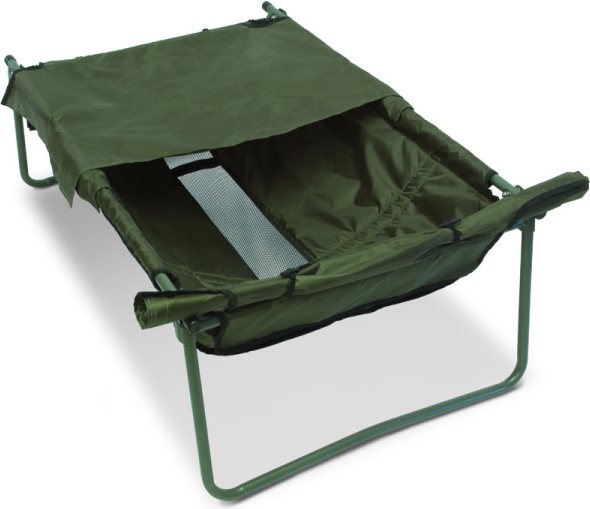
The Quickfish is the budget pick, and its whole design brief is speed and simplicity: it just unfolds, with no legs to extend or frames to tension, so it's fish-ready the moment it hits the ground.
The materials are honest for the money, a soft 210D PVC waterproof shell that wipes down easily, with two mesh panels in the top cover for airflow and visibility over the fish.
It's lightweight to carry, and Velcro straps hold it neatly closed when it's packed away, so it takes barrow or rucksack space without complaint.
There are no adjustable legs, no water retention and no premium padding at this price, so big-fish specialists should spend up the list. As the cheapest genuine cradle here for occasional sessions, it does the job.
Best suited to
Anglers after the cheapest genuine cradle that sets up instantly.
Pros
- Unfolds instantly, no setup
- Waterproof 210D PVC, wipes clean
- Cheapest cradle in the guide
Cons
- No legs or height adjustment
- Basic padding
Carp Cradle FAQs
Still choosing a cradle?
These are the questions I would settle before buying.
What is the difference between a carp cradle and an unhooking mat?
A mat is padding on the ground; a cradle adds raised, padded walls (and usually legs) that stop a flapping carp working its way off the padding and onto the bank. For bigger fish and longer handling, the containment is the safety feature.
Many fisheries now specify cradles for exactly that reason.
Should a carp cradle hold water?
A wet fish is a safe fish, and the premium designs make water a choice: the Trakker Sanctuary's internal cover can retain water in the cradle, and the Nash Hi-Protect swaps between a free-draining mesh base and a water-retaining panel in seconds.
Check the fishery's rules first, since some specify draining cradles and others prefer retained water.
What height should a carp cradle be set at?
As low as the handling allows, because any fall is shorter from a low cradle. Adjustable legs, fitted on the Trakker, Nash, Avid and Solar cradles here, level the cradle on uneven ground rather than raising it high.
The Nash Hi-Protect's raised mode is the exception with a purpose: holding big carp over cradle and lap to spare the angler's back.
Are carp cradles required on fisheries?
Increasingly, yes. Many day-ticket and syndicate waters now mandate a cradle or a high-sided mat for fish care, and some specify features like retention covers.
The rules travel with the venue, so a cradle that adapts, like the Nash with its removable retention panel, covers the widest range of waters.
Conclusion
Gone are the days of unhooking carp on your knee or on a patch of grass by the swim, and we must say this is a positive step forward. Above all, what anglers should be concerned with is fish safety, and then aesthetics.
With the best carp cradles, you hopefully will get both. By keeping your catch safe and secure you will be ensuring the future of the sport and perhaps more importantly of each individual fish that you catch.
Thanks for reading.
Tight Lines!
Related Articles...

7 Best Carp Landing Nets
If your landing net isn’t up to the job it’s going to lead to heartbreak at the worst possible time. Check out this review on the best carp landing nets today.

Best Fishing Scales
By using fishing scales, you can accurately and easily remove any doubt. This article details the key features of the best fishing scales on the market today.

The Best Carp Care Kit
Looking after the fish we catch is an important part of angling. This article is going to look at the best carp care kit, how to use it and where you can get one.